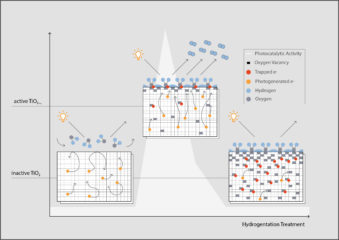
Our CENEM & GRK work entitled “Hydrogenated Anatase TiO2 Single Crystals: Defects Formation and Structural Changes as Microscopic Origin for Co-Catalyst Free Photocatalytic H2 Evolution Activity” was just published in the Journal of Materials Chemistry A (DOI: 10.1039/D1TA04809K).
The photocatalytic activity trend of the anatase epilayers is similar to that of anatase powders and brookite single crystals, the hydrogen evolution rate exhibits a typical maximum upon hydrogenation under moderate annealing temperatures. In this work, we link the observed photocatalytic trend to the structural and chemical evolution as revealed by complementary state-of-the art scattering as well es electron mircroscopy techniques. With this apporach, we detect specific physicochemical changes associated with the introduction of oxygen vacancies such as (i) the transition towards a sub-stoichiometric TiO2-x film, (ii) the formation of a nanoscale strained crystal surface, (iii) the agglomeration of point defects in the bulk of the anatase epilayer, (iv) a transition towards a Ti2O3 like symmetry at the film surface, and (v) an oxygen deficiency at the epilayer surface in particular prominent for the most active sample as a function of the hydrogenation parameters. These findings allow us to propose a model, which links detrimental and beneficial effects of Ti3+ centers and oxygen vacancies in the bulk and at the surface and their abundance to an optimum point defect configuration for photocatalytic water splitting by “grey” anatase.
Structural insight into hydrogenated TiO2, a sustainable and noble metal free approach for photocatalysis